


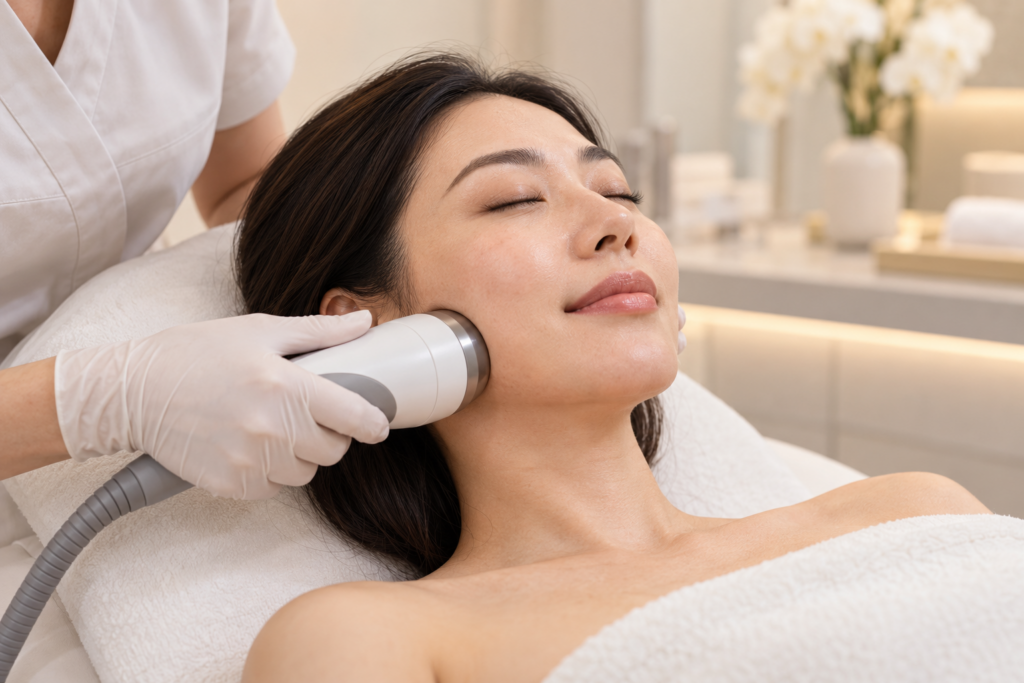

XERF is a non-invasive dual-frequency monopolar radiofrequency treatment that uses controlled RF energy at different tissue depths to address the appearance of skin laxity, reduced firmness and changes in skin quality.
As we age, changes in collagen, elastin and the skin’s supporting structures can gradually affect how firm and defined the face appears. The lower face may look less sculpted, the jawline may become less defined, and the skin may feel different from how it did years ago.
For those looking for a non-surgical approach to skin tightening, radiofrequency (RF) treatments have become an established option in aesthetic medicine.
XERF takes this approach a step further by combining two radiofrequency frequencies, 6.78 MHz and 2 MHz, with adjustable treatment depths. This allows RF energy to be delivered according to the treatment area and intended tissue depth.
But what does that actually mean for your skin?
XERF is a dual-frequency monopolar radiofrequency treatment designed for non-invasive skin tightening and tissue remodelling.
Unlike treatments that use needles or surgical incisions, XERF delivers RF energy through an external applicator placed against the skin.
The system uses two RF frequencies:
The treatment depth and energy settings can be adjusted according to factors such as the treatment area, tissue characteristics and the individual’s clinical goals.
This combination of frequencies and treatment depths is one of the key features of XERF.
To understand XERF, it helps to understand how radiofrequency (RF) energy interacts with the skin and underlying tissue.
RF energy generates controlled heat within tissue. When collagen is exposed to appropriate thermal energy, it can undergo structural changes, followed by a gradual collagen remodelling and renewal process.
This means the treatment is not simply about heating the surface of the skin.
The aim is to deliver controlled RF energy at selected tissue depths while maintaining controlled temperatures at the skin surface. XERF combines 6.78 MHz and 2 MHz radiofrequencies with different depth settings, allowing treatment parameters to be adjusted according to the area being treated.
Over time, the body’s natural collagen remodelling process may contribute to gradual changes in skin firmness and skin quality.
XERF uses two radiofrequency (RF) frequencies: 6.78 MHz and 2 MHz.
Different RF frequencies interact with tissue differently. Research investigating 6.78 MHz and 2 MHz RF has found differences in the distribution of thermal effects, including differences in the depth and distribution of thermal effects.
Rather than relying on a single frequency for every treatment area, XERF combines both frequencies with different treatment depth settings, allowing the treatment parameters to be adjusted according to the area being treated.
This enables the doctor to select the appropriate settings based on the treatment area, skin condition and individual assessment.
XERF may be considered for individuals concerned about the appearance of:
The suitability of XERF depends on the individual’s skin condition, degree of laxity, anatomy and treatment goals.
It is important to understand that XERF is not a surgical facelift. The degree of improvement achievable with a non-invasive treatment is different from that of surgery, and results vary between individuals.
For some patients, the goal may be to improve the appearance of firmness and maintain facial definition. For others, a different treatment may be more appropriate following a medical assessment.
Before treatment, the doctor assesses the treatment area and discusses the patient’s concerns, expectations and suitability for treatment.
The skin is then prepared before the XERF applicator is placed against the treatment area.
During treatment, controlled RF energy is delivered to selected areas. XERF incorporates temperature monitoring and cooling features designed to help regulate the treatment environment.
Patients may experience a warm sensation during treatment. Comfort levels can vary depending on the treatment area, settings and individual sensitivity.
Treatment parameters can be adjusted according to the patient’s anatomy and tolerance.
As a non-invasive RF treatment, XERF generally involves minimal downtime, allowing most individuals to return to their usual activities soon after treatment.
Some patients may experience temporary effects such as:
These effectsare generally temporary.
Your doctor will advise you on what to expect based on the treatment area and settings used.
Skin tightening typically occurs gradually over time. Radiofrequency (RF) treatment produces a thermal response within the tissue, while changes in skin firmness may develop gradually as part of the skin’s natural collagen remodelling and renewal process.Clinical research into dual-frequency monopolar RF has evaluated outcomes at different time points following treatment, including approximately one and three months after treatment.
This reflects an important point about energy-based treatments: the full treatment response may develop progressively rather than appearing all at once.
The timeline and degree of improvement vary between individuals.
There are several energy-based treatments available for skin tightening. While they may address similar skin concerns, they differ in how energy is delivered and how the treatment is performed.
Treatment | Technology | Key Differences |
XERF | Dual-frequency monopolar radiofrequency (6.78 MHz and 2 MHz) | Uses an external applicator to deliver RF energy with adjustable treatment depth settings. Does not involve needles or surgical incisions. |
Conventional RF | Generally uses a single radiofrequency | Delivers RF energy to tissue, with treatment characteristics depending on the device and settings used. |
HIFU | High-intensity focused ultrasound | Uses focused ultrasound energy to target selected tissue depths without needle penetration. |
RF Microneedling | Radiofrequency combined with microneedling | Uses fine needles to deliver RF energy into the skin at selected depths. |
The appropriate treatment depends on individual factors, including skin condition, facial anatomy, degree of laxity and treatment goals. A medical assessment can help determine which approach may be suitable.
Not necessarily.
A medical consultation is important before undergoing XERF or any energy-based aesthetic treatment.
Your doctor may consider factors including:
During the consultation, your doctor can explain whether XERF is appropriate for you or whether another treatment may be more suitable.
A treatment that works well for one person may not produce the same result for another.
Energy-based treatments may look straightforward from the outside, but treatment settings are not one-size-fits-all.
Factors such as tissue thickness, treatment area, anatomy, energy level and individual tolerance can influence how treatment is planned.
A doctor-led assessment allows the treatment to be considered in the context of your individual anatomy and concerns, rather than treating the device as a standalone solution.
The aim is not simply to select a treatment because it is popular. It is to determine whether the treatment is appropriate for the individual sitting in front of the doctor.
No. XERF is a radiofrequency treatment, not a laser.
It uses dual-frequency monopolar radiofrequency energy at 6.78 MHz and 2 MHz.
XERF is a non-invasive treatment. The RF energy is delivered through an external applicator rather than through needles or surgical incisions.
Treatment time depends on the area being treated and the treatment plan. Your doctor can advise you on the expected duration during your consultation.
There is no single treatment schedule that applies to everyone.
The number and frequency of treatments depend on individual concerns, treatment goals and clinical assessment.
Your doctor can recommend an appropriate treatment plan based on your skin and the degree of laxity being addressed.
Patients may experience warmth or discomfort during treatment, and individual tolerance varies.
XERF incorporates cooling and temperature-monitoring features designed to support treatment comfort and safety.
No. XERF is a non-invasive aesthetic treatment and should not be presented as equivalent to a surgical facelift.
It may be considered by individuals seeking a non-surgical approach to improving the appearance of skin laxity, but the expected degree of improvement is different from surgery.
The duration of results varies between individuals and may be influenced by factors such as age, skin characteristics, lifestyle and the natural ageing process.
Your doctor can discuss expected outcomes and whether maintenance treatment may be appropriate during your consultation.
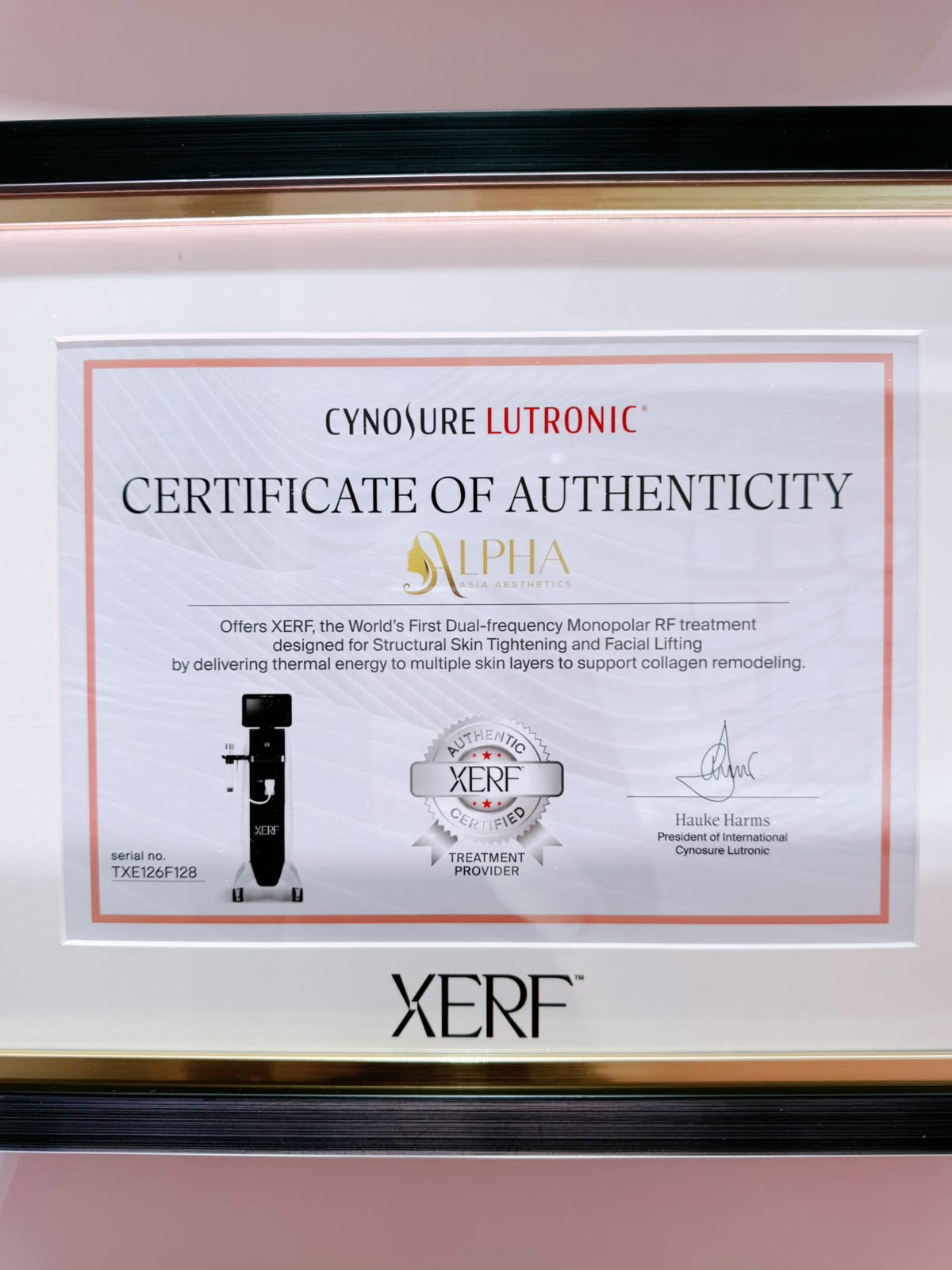
Not every skin-tightening treatment is suitable for everyone. Factors such as skin condition, facial anatomy and individual concerns can influence which approach may be appropriate.
A consultation with a qualified medical doctor can help you understand the available options, their potential benefits and limitations, and whether XERF is suitable for your needs.